AI video for business: process, cost, and why the tool does not equal the result
In roughly two years, video generation models have gone from clips of a few seconds full of errors to long scenes with smooth motion and lighting close to real footage. The question for business is no longer “can AI make a video”, but how to build the process, what it costs, and when it is appropriate.
Five steps of production
- Script and message. A language model can help, the final decision is made by a person.
- Storyboard. Shot breakdown, camera angles, visual style.
- Scene generation. Several versions are usually created for each scene, and the suitable one is selected.
- Editing and assembly. Music, voiceover (AI voice or human), multilingual subtitles.
- Quality control. Brand style, image details, copyright of the components used.
By format, the market splits into three groups: 2D animation for explaining services, AI-generated live-action-style video for brand promotion, and video with virtual presenters. Each group has its own process and its own cost. This is worth clarifying when you receive estimates.
Accessible, but quality is hard to reach
The main paradox of AI video is its own accessibility. When anyone can create a clip with a couple of commands, social media fills up with hastily made content: no visual consistency between scenes, unnatural motion, faceless messaging. As a result, many people equate AI video with this mass stream and conclude that the technology “can only do that”.
The gap between a video made from a single descriptive phrase and a professionally produced product is very large. Quality requires human involvement at every stage: script, art direction, refining each scene through several versions, sound and image post-production, final quality control. AI reduces the time and cost of each stage, but it does not replace production thinking.
The most common mistake we see: expecting AI to do everything from one description. That expectation is exactly what produces the stream of weak videos that distort the market’s view of the technology. The result depends on the script, the storyboard and the number of refinement rounds. Before signing a contract, ask the studio to show its process and samples of its work.
Cost and timelines
Traditional filming requires a crew, equipment, locations and actors. AI production removes most of the logistics. On the Vietnamese market, a one-to-two-minute company presentation video usually costs from several tens of millions of dong depending on complexity, with a timeline of one to two weeks including revision rounds. That is noticeably lower than traditional production at comparable image quality.
The technology’s current limitations, character consistency between scenes and control of small details in the frame, are exactly why manual control at input and output cannot be removed yet.
When AI video is appropriate
It works best for regular social media content, service explainer videos, internal training, and localising video into several languages. Projects with real acting emotion or an interview with a specific person remain with traditional filming or a combination of the two approaches.
The quality gap between AI video and real footage will keep narrowing, and costs will keep falling. Video will become the default content format for businesses of any size. Our process and indicative prices for AI video are published on the service page.
More articles

A cheap website costs a lot: what hides behind a 3 million VND price tag
There are plenty of "website for 3 million VND in a week" offers on the market. For a simple task it can be a reasonable option. In other cases it is the launch price, not the cost of ownership, and the difference shows up within six months to a year.
Read more
How much does a website cost in Vietnam in 2026: what drives the price
The first question in most incoming messages: "How much does a website cost?" Below we break down what makes up the price and give our reference ranges.
Read more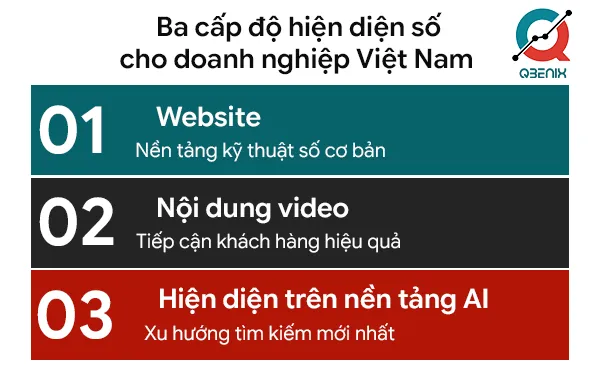
What does ChatGPT say about your company? Three levels of digital presence
Instead of keywords and a dozen open tabs, many now ask an AI assistant and get a ready answer with several cited sources.
Read more